
Kashmiri Walnut Grades Explained: Kernel Colour, Shell Types and Which to Buy
Walnut kernels are graded by colour, and the nuts by how easily their shells crack. Here is what extra light, light and amber really mean, how Kagzi differs from Wonth, and how to keep walnuts fresh.

NutsAndCrafts
27 August 20267 min read
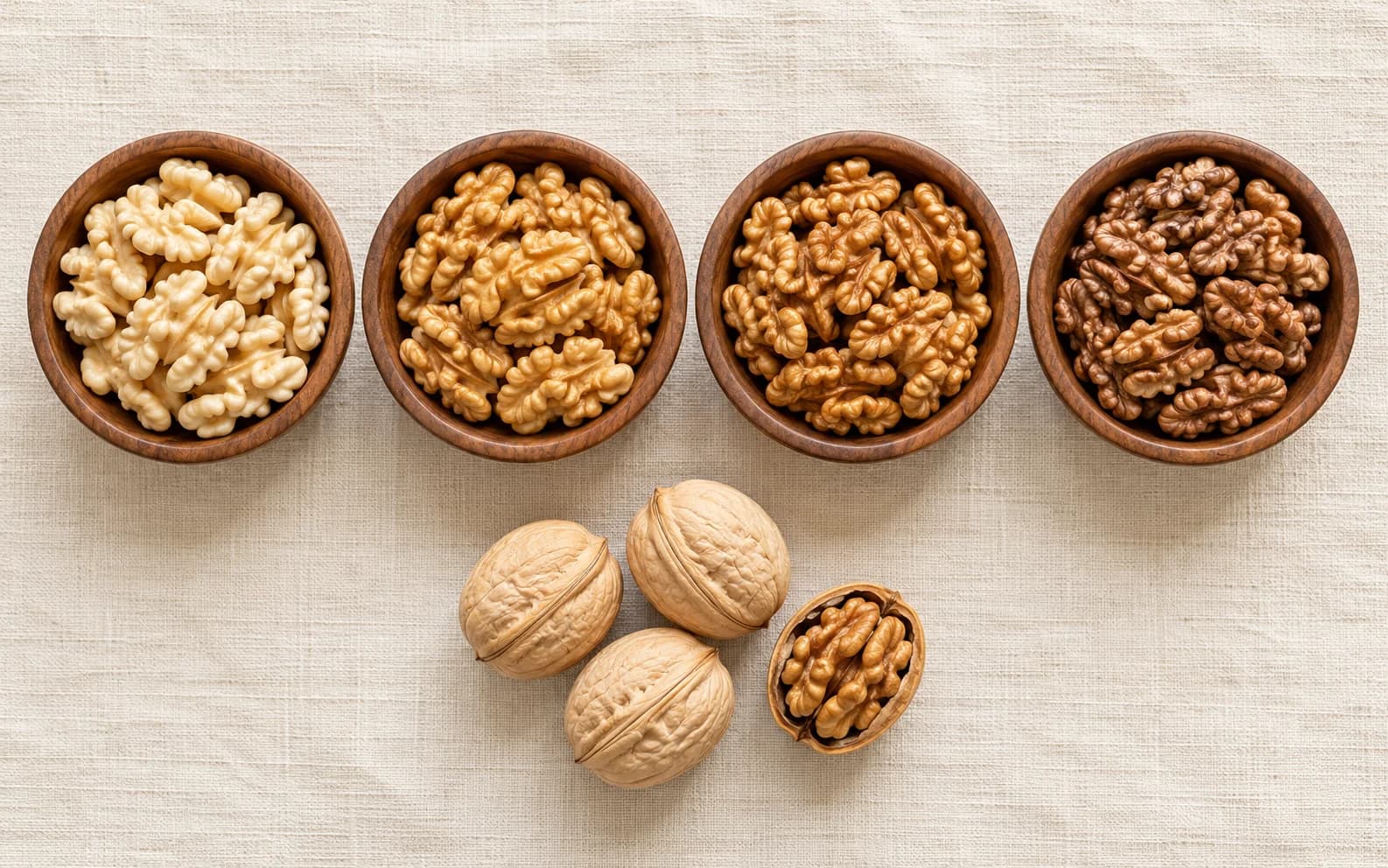
Kashmiri walnut kernels are graded by colour: extra light (sometimes called snow white), light, light amber and amber. The paler the kernel, the milder and sweeter it tastes and the fresher it usually is. The nuts are also sorted by shell, from thin, paper-shelled Kagzi to hard-shelled Wonth, and the kernels by size, from whole halves to pieces. For eating by the handful, choose light halves; for baking and cooking, light amber pieces give you the flavour for less.
Kashmir grows the large majority of India's walnuts, on tall, old trees scattered across the valley, along field edges and around village houses. The harvest comes in September and October. The nuts are knocked down with long poles, their green outer husks left to blacken and loosen, then peeled away. The nuts are washed and dried in the autumn sun before they are cracked and sorted. That sorting is where grades come from.
The grades
Once shelled, kernels are sorted by colour. That colour is the grade, and it tells you more than most people realise.
Grade | Colour | Taste | Best for |
|---|---|---|---|
Extra light, or "snow white" | Creamy white to very pale gold | The mildest and sweetest, with almost no bitterness | Eating by the handful, gifting |
Light | Light golden-brown | Sweet, with a clear walnut flavour | Everyday eating, soaking |
Light amber | Darker golden-brown | Fuller, with a slight bitter edge | Baking, chutneys, cooking |
Amber | Brown | Strong, noticeably bitter | Recipes with bold flavours |
Extra light kernels are the rarest and the most expensive. Light is the sweet spot for most people. Many shops, ours included, sell under simpler names such as Premium, Classic or Brown, so the listing should tell you which colour sits behind each name. If it doesn't, ask.
Shell types: Kagzi, Burzul and Wonth
In Kashmir, walnuts in the shell are also sorted by how thick the shell is, which decides how easily they crack and how cleanly the kernel comes out.
Type | Shell | How to crack it | The kernel |
|---|---|---|---|
Kagzi | Thin, papery (kagaz means paper) | By hand, or by pressing two together | Comes out whole and easily; the most prized |
Burzul | Medium | A nutcracker | Good; usually comes out in halves |
Wonth | Thick and very hard | A hammer | Hard to get out whole; often used for pieces or pressed for oil |
If you buy walnuts in the shell for eating, Kagzi is worth the extra. If you are cracking a sackful for the kitchen, Burzul is fine.
Halves and pieces
Kernels are sorted by size as well as colour.
Size | What it is | Why choose it |
|---|---|---|
Halves | The kernel split neatly in two, sometimes called butterflies | Keeps fresh longest, looks best, ideal for eating and gifting |
Quarters | Halves broken once more | A little cheaper; good for snacking and cooking |
Pieces | Smaller broken kernels | Cheapest; ideal for baking, chutneys and toppings |
Halves keep fresher for longer because less of the kernel is exposed to air. Pieces are no lower in quality for the same colour grade, just smaller, which makes them good value for anything that is going to be chopped anyway.
Why colour changes
Kernel colour depends on the tree, the weather at harvest and how carefully the nuts were dried, but above all on age and storage. Walnuts are rich in oil, and that oil slowly oxidises with time, heat and light. A kernel that was light at harvest can darken and turn bitter after months in a warm shop.
So a pale kernel isn't only a better grade. It is usually a fresher nut as well.
One thing colour does not tell you is the shell. Shells vary in shade from tree to tree, and some sellers wash walnuts to make the shells look paler and more uniform. A very white, perfectly even shell may simply have been bleached. It is the kernel inside that is graded.
Walnut nutrition
Walnuts have more plant omega-3 than any other common nut, in the form of alpha-linolenic acid (ALA).
Per 28 g (about 14 halves) | Amount |
|---|---|
Energy | about 185 kcal |
Protein | about 4.3 g |
Fat | about 18.5 g, mostly polyunsaturated |
Omega-3 (ALA) | about 2.5 g |
Fibre | about 1.9 g |
How to keep walnuts fresh
Because of all that oil, walnuts go stale faster than most nuts. How you store them matters more than almost anything else.
Form | Cool, dark cupboard | Fridge | Freezer |
|---|---|---|---|
In the shell | A few months | Up to about a year | Longer still |
Kernels | A few weeks in hot weather | Up to about six months | Up to about a year |
- Keep kernels in an airtight container, so they don't pick up smells from the fridge.
- Freeze them if you bought a lot. They thaw in minutes and can be used straight from frozen.
- Smell before you eat. Fresh walnuts smell mild, sweet and nutty. Stale ones smell sharp, like paint or old oil, and taste bitter.
How to tell fresh walnuts when you buy
- The kernels look plump and evenly coloured, not shrivelled or blotchy.
- They snap cleanly, rather than bending.
- There is no dust, powder or webbing in the bag.
- They taste sweet, with only a mild bitterness from the skin.
- The pack shows a recent packing date, ideally from the latest harvest.
What to buy
You want | Choose |
|---|---|
A handful a day, as they are | Light halves |
Soaked walnuts in the morning | Light halves or quarters |
Gifts for Eid, Diwali or weddings | Extra light or light halves |
Baking, brownies and cakes | Light amber pieces |
Chutneys, salads and cooking | Light amber or amber pieces |
The longest shelf life | Kagzi walnuts in the shell |
Frequently asked questions
Are dark walnut kernels bad?
Not necessarily. Darker kernels are a lower grade, with a stronger and more bitter taste, but they are perfectly good to cook with. A kernel that smells of paint, though, has gone rancid and should be thrown away, whatever its colour.
Why do my walnuts taste bitter?
A little bitterness comes from the thin skin on the kernel, and is normal. Strong bitterness usually means the walnuts are old or have been stored somewhere warm. Soaking them for a few hours softens the bitterness of the skin.
How many walnuts should I eat a day?
A handful, about 28 grams, is the usual serving: around seven whole walnuts, or fourteen halves.
Should I buy walnuts in the shell or as kernels?
In the shell if you want them to keep longer and don't mind cracking them. Kernels if you want convenience. Buy kernels in amounts you will finish within a few months, and keep them cold.
 Shop Kashmiri walnutsKashmiri Walnut Kernels (Akhrot Giri)