
Mamra vs California Almonds: How to Tell Them Apart, and Which to Buy
Mamra almonds cost two to three times as much as California almonds, and plenty of the "Mamra" on sale isn't. Here is how to tell them apart by shape, skin, oil and taste.

NutsAndCrafts
3 September 20267 min read
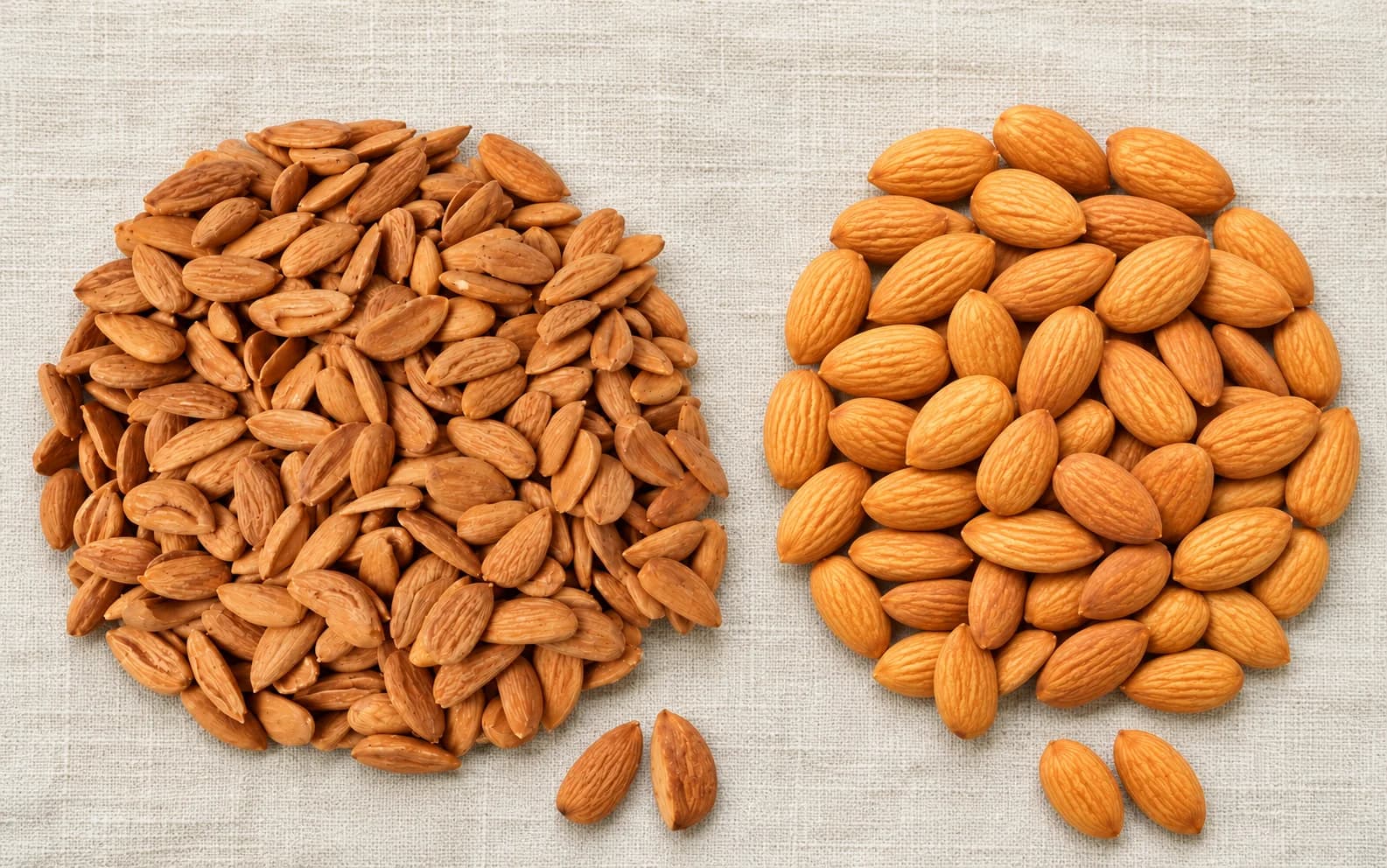
Mamra almonds are small, concave and boat-shaped, with a darker, deeply wrinkled skin and a rich, oily, sweet taste. California almonds are larger, flatter, smoother and uniform, and taste milder and drier. Mamra trees crop lightly and grow mainly in Iran, Afghanistan and Kashmir, which is why Mamra costs two to three times as much. Both are good food: Mamra is the traditional choice for soaking and badam milk, California almonds for baking and snacking.
Walk down any dry fruit aisle and you will see "Mamra" on almonds at very different prices. Some of it is genuine Mamra. A fair amount is California almonds, or Afghan Gurbandi, with a better label. The two main varieties are easy to tell apart once you have held both, and this guide shows you how.
The short version
Mamra | California | Gurbandi | |
|---|---|---|---|
Shape | Concave, boat-shaped, often a little crooked | Flat, broad, even | Small and plump |
Size | Small to medium | Large | Small |
Skin | Dark brown, rough, deeply wrinkled | Light brown, smooth | Dark, wrinkled |
Feel | Oily; leaves a mark on paper | Dry | Fairly oily |
Taste | Rich, sweet, buttery | Mild, crunchy | Rich, sometimes with a faint bitter note |
Grown in | Iran, Afghanistan, Kashmir | Mostly California, USA | Afghanistan |
Best for | Soaking, badam milk, gifting | Baking, snacking, almond flour | Soaking, sweets |
Price | Highest | Lowest | In between |
Shape: the first giveaway
Pour a handful onto a plate and look at them side by side.
Mamra almonds are small and concave: hollowed on one side like a little boat, and often slightly twisted or crooked. Look at twenty and no two are quite the same. That irregularity is a good sign.
California almonds are bigger, flatter and smooth, and they are remarkably uniform, as if they were made in a mould. That evenness comes from orchards bred and managed for consistent, high yields.
Skin and colour
Mamra skin is darker, rougher and more deeply wrinkled, a reddish to chocolate brown. California almonds are a lighter tan with a smoother skin. If a "Mamra" batch is pale, smooth and perfectly even, be suspicious.
Oil: the real difference
This is what you are paying for. Mamra almonds feel and taste noticeably oilier than California almonds. A simple check: press a Mamra kernel hard onto a piece of plain paper, or cut it and rub the cut face on the paper. It leaves a clear oily mark. A California almond leaves much less.
Sellers often quote oil percentages for Mamra. Independent figures vary from lot to lot, so we would trust your palate and the paper over a number on a label.
Taste
Eat one of each, slowly. Mamra is rich, sweet and slightly waxy, with a long, buttery finish. California almonds are crunchier, drier and milder. Neither should ever taste sharply bitter. A strongly bitter almond is a bitter almond variety, which contains compounds you shouldn't eat in quantity, so spit it out and discard it.
How to spot fake Mamra
- Too uniform. Genuine Mamra varies in size and shape. A bag of identical kernels is almost certainly not Mamra.
- Too big. Mamra is a small almond. Large kernels sold as Mamra are usually sorted California stock.
- Too pale and smooth. Mamra skin is dark and wrinkled.
- Too cheap. Mamra costs two to three times as much as California almonds for good reasons. A price close to California's is a red flag.
- Mixed lots. Check a full handful, not the top layer. Some sellers mix a little real Mamra over cheaper almonds.
Nutrition
Almonds are among the most nutritious nuts you can eat. The standard figures below are for almonds in general; Mamra isn't listed separately in the usual nutrition tables, so treat these as a close guide for both.
Per 28 g (about 23 almonds) | Amount |
|---|---|
Energy | about 164 kcal |
Protein | about 6 g |
Fat | about 14 g, mostly monounsaturated |
Fibre | about 3.5 g |
Vitamin E | about 7 mg, roughly half a day's needs |
Magnesium | about 76 mg |
Calcium | about 76 mg |
Soaking almonds: how and why
Soaking almonds overnight is one of the oldest habits in Indian kitchens, and Mamra is the almond it was made for.
- Put five to seven almonds in a small bowl and cover them with water.
- Leave them overnight, eight to twelve hours.
- In the morning, pinch off the skins. They slip off easily once soaked.
- Eat them on their own, or blend them into badam milk.
Soaked almonds are softer, easier to chew and, many people find, easier to digest. Claims that soaking unlocks dramatically more nutrition are stronger than the evidence, but the habit is a good one: a small, filling handful first thing in the morning.
Why Mamra costs more
Mamra trees grow slowly, crop lightly and are mostly tended on small family orchards in Iran, Afghanistan and Kashmir, often without irrigation. California grows around four-fifths of the world's almonds on vast, irrigated, mechanised orchards. The price gap isn't marketing. It is the difference between how the two are grown, and how much each tree gives.
Kashmir's own almond season begins with the blossom. Every spring the orchards of the valley, and Srinagar's Badamwari garden below Hari Parbat, turn pink and white weeks before the rest of the valley wakes up.
Which should you buy?
You want | Choose |
|---|---|
Soaked almonds every morning | Mamra |
Badam milk, or traditional sweets | Mamra |
A gift that will be noticed | Mamra |
Baking, cakes and almond flour | California |
Everyday snacking on a budget | California |
Something in between, for soaking | Gurbandi |
How to store almonds
- Keep them in an airtight jar, away from sunlight and the stove.
- In summer, keep them in the fridge. Mamra's high oil content turns rancid sooner in the heat.
- Buy whole kernels rather than sliced or blanched ones, which lose freshness faster and can't be judged by shape.
- Smell before you eat. Fresh almonds smell sweet and nutty; rancid ones smell sharp, like old paint.
Frequently asked questions
Are Mamra almonds healthier than California almonds?
Both are excellent food with very similar nutrition. Mamra's appeal is its richer taste and texture, and its place in tradition, rather than a dramatic nutritional advantage.
Are all Mamra almonds from Kashmir?
No. Mamra is a variety, not a place. Most Mamra sold in India comes from Iran and Afghanistan; Kashmir grows a smaller amount. The label should say where yours were grown.
How many almonds should I eat a day?
A handful, about 20 to 23 almonds or 28 grams, is the serving most nutrition guidance uses. If you are soaking Mamra, five to seven a morning is the traditional amount.
What is the difference between Mamra and Gurbandi?
Gurbandi is a small Afghan almond, plump and oily like Mamra but rounder and usually cheaper, sometimes with a faintly bitter note. It is good almond in its own right. It just shouldn't be sold as Mamra.